








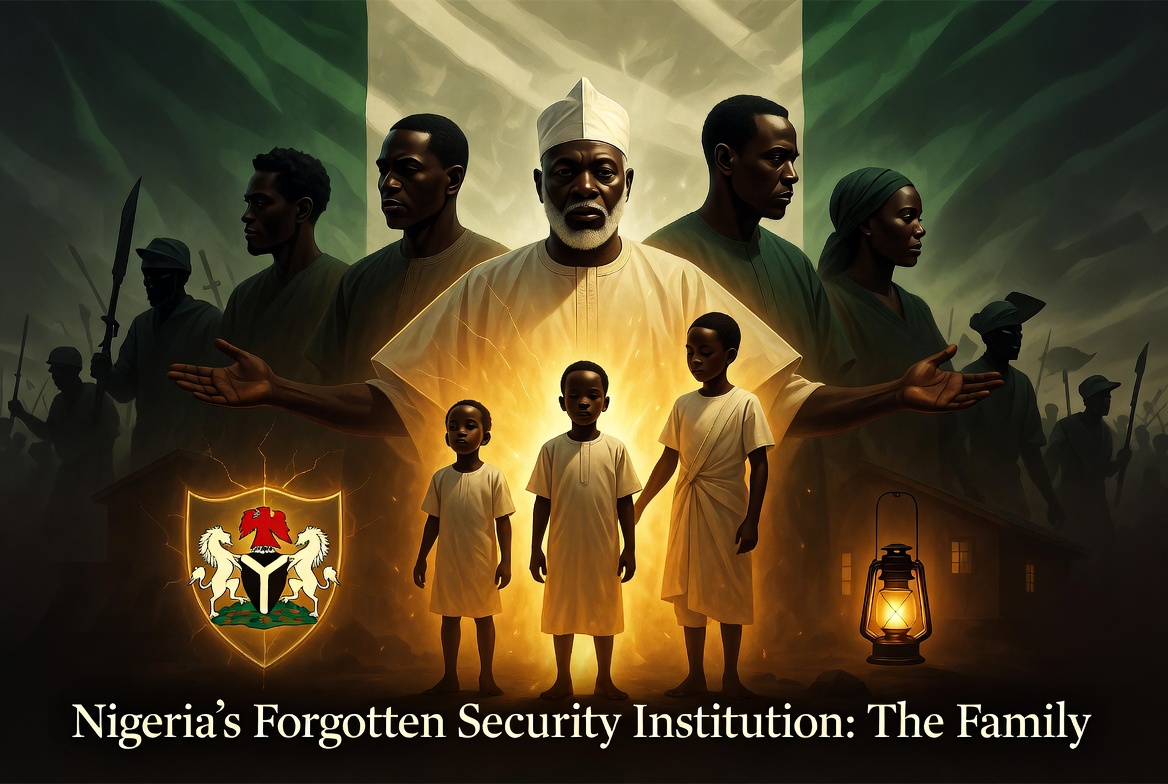
Nigeria’s Forgotten Security Institution: The Family
By Segun SHOWUNMI
As part of the broader effort to refocus Nigeria, we must be willing to revisit and reexamine the idea of the Nigerian family. If the concept proves too broad or complex, then we should return to the foundational cultures that make up our nation and examine the family through the lenses of our various ethnic traditions.
What does family mean to the Yoruba? To the Hausa? To the Igbo? To the Fulani? And to the many minority ethnic nationalities that enrich the Nigerian federation? These are not merely academic questions. They go to the heart of our values, our responsibilities, our sense of community, and the moral expectations that guide individual conduct.
There is also a pressing national reason for this conversation. Despite enormous investments in security infrastructure, personnel, intelligence gathering, and law enforcement, Nigeria continues to grapple with levels of criminality that often appear resistant to conventional solutions. This suggests that the challenge is not solely one of policing or security architecture. It is also a question of social values, cultural orientation, and the institutions that shape human behaviour long before an individual encounters the criminal justice system.
Historically, the family served as the first school of citizenship. Within the traditional Yoruba family, a child’s conduct reflected on the entire lineage. Among the Hausa, Fulani, Igbo, and numerous other ethnic groups, communal expectations imposed obligations that discouraged antisocial behaviour and rewarded character, industry, and responsibility. Families, elders, age grades, community associations, and traditional institutions all played active roles in shaping conduct and enforcing social norms.
Today, many of these institutions have weakened under the pressures of urbanisation, economic hardship, migration, and the rapid pace of social change. The result is that society increasingly relies on formal security institutions to solve problems that were once addressed at the family and community level. Yet no nation can police its way out of a moral crisis. Security agencies can deter and punish crime, but they cannot by themselves instill values, build character, or create a sense of duty to one’s community.
This is why a national conversation about the family is essential. If we can better understand how our various cultures defined responsibility, honour, accountability, respect, and communal obligation, we may recover tools that help prevent criminality before it begins. The objective is not to romanticise the past or reject modern realities, but to identify enduring principles that can strengthen social cohesion in the present.
The states should take the lead in this reorientation effort. Through schools, cultural institutions, traditional rulers, faith-based organisations, youth programmes, and public enlightenment campaigns, states can help reconnect younger generations with values that have historically promoted social order and communal responsibility.
The fight against crime cannot be won solely with more weapons, more checkpoints, or larger security budgets. It must also be fought in homes, schools, communities, and cultural institutions. A society that succeeds in raising responsible citizens reduces the burden on its security agencies. A society that neglects the formation of character will find that no amount of security expenditure is ever enough.
If Nigeria is to stem the tide of excessive criminality that has defied logic and consumed vast security investments, then we must look beyond enforcement and return to the foundations of social order. The family remains the most important institution in that regard. Rebuilding it through the best values of our diverse cultures may be one of the most consequential investments we can make in the security, stability, and civilizational renewal of our nation.
Otunba Segun Showunmi
The Alternative.