


By Lukman OMIKUNLE
Russia’s perceived influence among young Africans has risen to 54%, surpassing France, while 80% express concern about foreign powers, a new survey finds
Russia Overtakes France in African Youth Influence Survey 2026
Russia’s perceived influence across Africa has increased significantly, overtaking France in a new survey of young Africans, even as four in five respondents express concern about foreign powers’ influence over their countries.
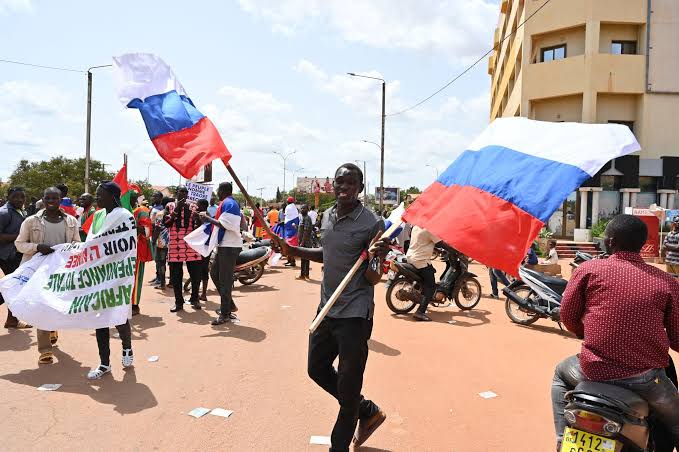
The findings of the African Youth Survey 2026, released as Russian President Vladimir Putin hosts African leaders at the Russia–Africa Summit in Moscow, show that 54 per cent of young Africans surveyed believe Russia has some or significant influence in their countries, up from 44 per cent in 2024.
France’s perceived influence, meanwhile, stands at 47 per cent, placing Russia ahead of its European rival in the latest assessment of foreign powers’ standing among Africa’s younger generation.
The survey also found that 83 per cent of respondents who recognise Russian influence view it positively, while 86 per cent regard Russia as either a strong or somewhat of an ally.
However, the growing appeal of Moscow comes amid mounting anxiety about external interference, with 80 per cent of respondents saying they are concerned about foreign influence in their countries, compared with 72 per cent in 2024.
The survey, commissioned by the Ichikowitz Family Foundation and conducted by research firm PSB Insights, involved 4,901 face-to-face interviews with Africans aged 18 to 24 across 16 countries in March 2026.
Russia’s perceived influence varies considerably across the continent. Burkina Faso recorded the highest proportion of respondents who said Moscow had some or significant influence, at 95 per cent, followed by Congo Brazzaville with 69 per cent and Chad with 65 per cent.
At the other end of the scale, only 24 per cent of young Liberians and 26 per cent of young Somalis identified Russia as influential in their countries, highlighting the considerable differences in perceptions of Moscow across Africa.
Ivor Ichikowitz, founder and commissioner of the African Youth Survey, said Russia’s growing standing among young Africans was a development other international powers could not afford to ignore.
“Russia has achieved something that would have been difficult to imagine a few years ago. It has overtaken France in perceived influence, and large numbers of young Africans now see it as an ally. Those figures are real and deserve to be taken seriously. Other capitals ignore them at their peril,” he said.
Ichikowitz, however, cautioned against interpreting the findings as unconditional support for foreign powers.
“But approval is not a blank cheque. Africa’s young people welcome partners who can help them build their future, not foreign powers who expect to control it. They want to know who benefits from the deals being signed, who owns the resources and whether promises of security and investment lead to a better life for Africans,” he added.
The survey found that concern about foreign influence was particularly high in Mozambique, where 91 per cent of respondents expressed unease, followed by South Africa at 88 per cent and Liberia at 85 per cent.
Even in Burkina Faso, where Russia’s perceived influence reached 95 per cent, 72 per cent of respondents remained concerned about foreign influence generally.
The researchers noted that the survey did not ask respondents whether they specifically distrusted Russia’s intentions. The findings therefore reflect broader concerns about foreign powers rather than a direct verdict on Moscow’s motives.
Independent assessments have also identified strategic and economic interests in Russia’s expanding engagement with Africa, including military cooperation and access to natural resources. Such assessments concern Russia’s activities and should not be confused with the survey’s findings on public opinion.
Beyond perceptions of foreign influence, the survey examined the qualities young Africans consider most important when choosing international partners.
Economic and infrastructure investment ranked highest, with 43 per cent of respondents identifying it as a priority. Respect for natural resources followed at 39 per cent, while democratic values and a strong human rights record, alongside respect for sovereignty and non-interference, each attracted 34 per cent.
Technology and knowledge transfer was cited by 30 per cent, while 29 per cent identified military or security assistance as a key consideration. Only 15 per cent placed shared history or cultural ties among their leading priorities.
The findings suggest that young Africans are weighing international partnerships against practical economic benefits and the protection of national interests.
More than half of respondents, 55 per cent, said they preferred alliances that deliver trade and investment, even when the partner has a different political system. Another 42 per cent favoured countries with similar values and systems of government, even if those partners were less effective at delivering practical benefits.
On broader foreign policy, 60 per cent said their countries should build strong alliances with one or two major global powers to secure long-term advantages, while 37 per cent preferred neutrality.
The survey also found that 81 per cent of respondents considered the United States influential in their countries, placing it ahead of China at 79 per cent. Russia followed at 54 per cent, while France recorded 47 per cent.
Despite differing views of international partners, 73 per cent of young Africans surveyed said democracy was always preferable to other forms of government. Meanwhile, 80 per cent supported reforming the United Nations Security Council to provide permanent representation for Africa.
The findings come as Russia seeks to deepen diplomatic, economic and security relations with African governments at its two-day summit in Moscow, scheduled for October 28 and 29.
Moscow’s expanding engagement with the continent, including security partnerships in the Sahel, has drawn international attention as African governments reassess their relationships with traditional Western partners and other global powers.
The survey, however, suggests that Russia’s growing visibility and favourable ratings do not eliminate wider concerns about foreign involvement in African affairs.
According to the foundation, the African Youth Survey has covered 28 countries since its launch in 2020, recording 18,882 face-to-face interviews across four waves. The 2026 edition surveyed young people in Burkina Faso, Chad, Congo Brazzaville, the Democratic Republic of the Congo, Ethiopia, Ghana, Kenya, Liberia, Mozambique, Nigeria, Rwanda, Somalia, South Africa, Togo, Zambia and Zimbabwe.
As the summit continues, the findings place economic opportunity, resource protection and national sovereignty at the centre of the expectations young Africans have of international partners. For Moscow and other global powers seeking stronger ties with the continent, the survey indicates that favourable public perceptions must be matched by partnerships that deliver tangible benefits while respecting African countries’ right to determine their own futures