
Home Blog Page 66

Fuel Price Set to Hit N1,000/Litre as Dangote Refinery Raises Gantry Rate Over Middle East Crisis

0

Nigerians should brace for higher fuel costs as petroleum marketers and retailers have announced an imminent increase in the pump price of Premium Motor Spirit (PMS) beginning Tuesday and Wednesday, March 3 and 4, 2026.

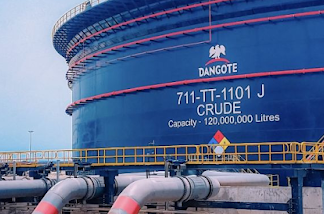
The development follows a hike in the gantry price of petrol by the Dangote Refinery, which raised its rate to N874 per litre on Monday.

Industry sources attributed the adjustment—an increase of at least N75—to surging global crude oil prices triggered by escalating tensions involving Iran, the United States, and Israel.

The conflict has disrupted oil infrastructure and shipping routes in the Middle East, particularly around the Strait of Hormuz, a critical corridor for global crude supply. Attacks on major energy facilities, including Saudi Arabia’s Ras Tanura refinery, have intensified fears of supply constraints.

As of Monday, Brent crude rose to $78.50 per barrel, while West Texas Intermediate traded at $71.84. Analysts warn that prolonged hostilities could further destabilise global oil and gas markets.

Goldman Sachs projected that if the crisis persists, liquefied natural gas (LNG) prices to Europe and Asia could surge to $25 per million British thermal units (MMBtu).

Reacting to the development, the spokesperson of the Independent Petroleum Marketers Association of Nigeria (IPMAN), Chinedu Ukadike, said retail petrol prices in the Federal Capital Territory and surrounding areas could jump from N870–N899 per litre to between N980 and N1,000.

“There will be price fluctuation and increase. That is the ‘gain’ we are getting from the Iran-US-Israel war,” Ukadike said, urging Nigerians not to panic-buy as supply remains stable.

He added that although global crude prices are rising, Dangote Refinery is expected to maintain steady supply, with the Federal Government continuing to provide crude oil in naira to cushion volatility.

Similarly, the National President of the Petroleum Products Retail Outlets Owners Association of Nigeria (PETROAN), Billy Gillis-Harry, said the hike was inevitable given the geopolitical realities.

“You know that crude oil price is rising as hostilities escalate in the Middle East. Iran is a major supplier of crude oil. Any disruption in its operations will affect global crude prices—and prices will hike,” he stated.

While marketers insist there is no looming fuel scarcity, they warn that transportation and logistics costs may further influence final pump prices nationwide.

With global crude markets under pressure and energy infrastructure under threat, Nigeria’s domestic fuel market appears set for another round of price adjustments—placing additional strain on consumers already grappling with rising living costs.

Tragedy on the Road: Orowole Kolapoz (Kola Onifoto) Dies in Lone Motorcycle Crash

0

Popular Nigerian photographer and biker, Orowole Kolapoz, widely known as Kola Onifoto, has died following a lone motorcycle accident in Lagos.

The 32-year-old travel enthusiast and brand influencer was reportedly involved in the crash on Sunday during what he described as his first solo motorcycle trip outside Lagos.

Just hours before the accident, Kola had shared his excitement on Facebook, announcing that he was heading to Akure on his bike.

“Big shout out to those who have ridden their bikes to every state in this country, to Africa, and across the world, especially women. My eye see wheeen,” he wrote on Sunday, March 1, 2026.

Friends later disclosed that he was involved in a crash and initially rushed to the emergency unit of the Federal Road Safety Corps (FRSC) at 7UP, Ojota. He was subsequently transferred to the Lagos University Teaching Hospital (LUTH), Idi-Araba, where supporters flooded social media with prayers for his recovery.

Tragically, he succumbed to his injuries in the early hours of Monday, March 2.

News of his passing sparked an avalanche of tributes from friends, followers, and members of the biking and creative communities.

Facebook user Georgiana Onyinye wrote, “We prayed, we cried, and hoped to hear better news, but unfortunately, death had other plans. Kola fought so hard. You tried to stay alive, but death had other plans. You will be greatly remembered. Rest easy, K.”

Victoria Ayagwu also expressed heartbreak, revealing she had initially hoped for a miracle despite hearing grim news from close sources.

“All the posts was just me keeping my hopes up… because I heard from his closest friend yesterday night that he’s gone. I don’t know why we are here at all. Kola spoilt my night and my whole day,” she wrote.

Emmanuel Collins added, “Hot tears rolled down my cheeks. Haven’t had any encounter with him, but the way he fights for people drew me closer to his page. Goodnight Mr Kola.”

Naomi Balogun described his death as particularly painful, saying she had only recently begun following his writings and felt deeply shaken by the news.

In January, Kola had celebrated fulfilling his dream of becoming a biker, proudly sharing a photograph beside his newly acquired motorcycle — a milestone that symbolised his passion for adventure and travel.

Details surrounding the exact cause of the accident remain unclear. Efforts to reach the Lagos Sector Command spokesperson of the FRSC, Oluwadamilola Jayeola, were unsuccessful as calls and text messages had not been returned at the time of filing this report.

Kola’s untimely death has left a void in Nigeria’s creative and biking communities, with many remembering him as a vibrant spirit whose love for travel and storytelling inspired thousands online.

IPC, Akinola Demand Apology from Alex Otti Over ‘Stupid’ Remark to Journalist

0

The International Press Centre (IPC) and veteran journalist Richard Akinola II have demanded a public apology from Abia State Governor, Alex Otti, over his verbal attack on a journalist during a media chat.

The controversy erupted during a question-and-answer session organised by the governor, where Chika Nwabueze of Don Media Group asked Otti to provide verifiable data showing that his policies had improved residents’ economic and living conditions beyond infrastructure development.

Rather than respond directly, Otti reportedly lashed out at the journalist, calling him “stupid” and questioning his professional competence in a moment captured in a now-viral video.

In a statement issued by its Safety and Protection of Journalists (SPJ) Hub, signed by Press Freedom Officer Melody Akinjiyan, the IPC described the governor’s conduct as “condescending and unexpected from an elected leader accountable to citizens.”

Executive Director Lanre Arogundade defended Nwabueze’s line of questioning, stating:

“Mr. Chika was within his constitutional and professional rights to ask the question. Any public figure, especially a duty bearer, should expect scrutiny. This was an opportunity for the governor to detail his performance.”

The IPC-SPJ Hub questioned the rationale behind convening a media chat if critical questions would not be entertained and urged Otti to issue an unreserved public apology.

Veteran journalist Richard Akinola II also weighed in, expressing disappointment.

“Alex Otti, tender an unreserved apology to that journalist for your ‘irresponsible and stupid’ comment. As your fan, I’m terribly disappointed,” he wrote.

Critics argue that the episode reflects intolerance incompatible with democratic leadership. They stressed that public office demands openness to scrutiny, emotional restraint, and fact-based responses rather than personal attacks.

“Public office is a responsibility, not a throne. Journalists bolster democracy, not threaten it. A confident leader counters criticism with evidence; an insecure one attacks the messenger,” one commentator noted.

The incident adds to a pattern of confrontations between public officials and journalists in Nigeria. Former Aviation Minister Femi Fani-Kayode and former Ebonyi State Governor David Umahi previously faced backlash for verbally attacking journalists before later apologising.

Meanwhile, the International Press Institute Nigeria (IPI Nigeria) recently unveiled its “Book of Infamy” — officially titled the Book of Accountability for Journalists’ Rights — listing state actors accused of anti-press actions.

Among those named were Niger State Governor Mohammed Umar Bago, cited for ordering the closure of Badeggi FM in August 2025, and Akwa Ibom State Governor Umo Eno, accused of expelling two Channels TV journalists from Government House duties in May 2025.

As backlash continues, observers say Otti’s response risks denting his reformist image and reigniting broader concerns about press freedom and accountability in Nigeria’s democracy.

Dangote Targets Steel, Power, Ports in New Industrial Push

0

Dangote Targets Steel, Power, Ports in New Industrial Push

President of Dangote Group, Aliko Dangote, has unveiled plans to expand into steel production, electricity generation and port development as part of a broader ambition to accelerate industrialisation across Africa.

Dangote, whose conglomerate spans cement, sugar, salt, fertiliser, and petrochemicals, said his long term goal is to deepen Africa’s manufacturing base beyond oil refining and position the continent as a global industrial force.

His latest flagship project, the Dangote Petroleum Refinery & Petrochemicals, is now operational and producing about 650,000 barrels of refined products daily. He said output is expected to double within the next three year as expansion plans progress.

However, Dangote in a recent interview with The New York Times, indicated that refining is only one phase of a larger vision.

“We have to industrialise Africa,” he said, noting that his next focus areas include the steel industry, expanding access to electricity and building additional port infrastructure to support large scale manufacturing and trade.

Industry analysts say entry into steel would position the group in a sector critical to infrastructure, housing and heavy industry, while investments in power and ports could address two of Nigeria’s most persistent constraints to economic growth.

Dangote cited India’s Tata Group as a model for diversified industrial expansion, describing the conglomerate’s multi sector footprint as an example of how large scale manufacturing can transform emerging economies.

Beyond expansion, Dangote said job creation remains central to his strategy. With Nigeria projected to require between 40 and 50 million new jobs by 2030, he argued that large scale industrial projects are essential to absorbing the country’s growing youth population.

The refinery alone currently employs about 30,000 workers, approximately 80 per cent of them Nigerians. Expansion across new sectors is expected to raise total employment within the group to about 65,000.

Dangote also announced plans to list shares in the refinery on the Nigerian stock market, a move that would broaden local participation in the asset.

Despite progress, he acknowledged that infrastructure gaps and crude supply challenges remain obstacles. He has previously raised concerns about logistics bottlenecks and inefficiencies in the oil value chain that complicate feedstock supply to the refinery.

Nevertheless, Dangote said the group would continue to invest aggressively in sectors that reduce import dependence and retain economic value within Africa.

“Nobody dared to do it, so we did it,” he said, reiterating his belief that large scale private investment is key to transforming Nigeria’s industrial landscape.

With cement plants operating across multiple African countries and a refinery that has reshaped Nigeria’s downstream outlook, Dangote’s next push into steel, electricity and port infrastructure signals a new phase in his ambition to industrialise the continent. Read More

Tinubu to Swear In Olatunji Disu as Substantive IGP After Police Council’s Unanimous Backing

0

President Bola Tinubu is set to formally swear in Olatunji Disu as the substantive Inspector-General of Police (IGP) on Wednesday, following his unanimous endorsement by the Nigeria Police Council.

The swearing-in ceremony will take place during the Federal Executive Council (FEC) meeting scheduled for the same day, according to a statement issued on Monday by the President’s Special Adviser on Information and Strategy, Bayo Onanuga.

The Nigeria Police Council meeting, held at the State House in Abuja, was presided over by Tinubu and attended by Vice President Kashim Shettima, state governors, and the Chairman of the Police Service Commission, retired DIG Hashimu Argungu, in line with constitutional provisions.

Other top government officials present included the Secretary to the Government of the Federation, George Akume; National Security Adviser, Nuhu Ribadu; Chief of Staff to the President, Femi Gbajabiamila; Minister of Police Affairs, Ibrahim Gaidam; Minister of the Federal Capital Territory, Nyesom Wike; and Head of Service, Mrs Esther Walson-Jack.

Governors Hail Disu’s Professional Track Record

Lagos State Governor Babajide Sanwo-Olu reportedly praised Disu’s exemplary service, particularly his tenure as Commander of the Rapid Response Squad (RRS) in Lagos from 2015 to 2021, where he earned recognition for effective crime control.

Similarly, Nasarawa State Governor Abdullahi Sule described Disu’s appointment as well-deserved, citing his distinguished career record.

Wike also commended Disu’s professionalism, recalling his service in Rivers State as Assistant Commissioner of Police in charge of the Criminal Investigation Department and anti-kidnapping unit between 2014 and 2015. He further noted Disu’s impactful tenure as Commissioner of Police in the FCT Command, where he strengthened security operations within the territory.

Enugu State Governor Peter Mbah seconded the motion endorsing the appointment.

From Acting to Substantive IGP

Disu’s confirmation comes barely a week after President Tinubu appointed him Acting IGP following the resignation of Kayode Egbetokun.

Born on April 13, 1966, in Lagos State, the 59-year-old joined the Nigeria Police Force on May 18, 1992, as a Cadet Assistant Superintendent of Police. Over the years, he has built a reputation as a seasoned crime fighter and administrator.

He holds multiple qualifications in public administration, forensic investigation, criminology, security studies, legal psychology, and entrepreneurship—credentials the Presidency says underscore his commitment to modern, knowledge-driven policing.

Before his elevation, Disu served as Assistant Inspector-General of Police in charge of the Special Protection Unit and the Force CID Annex in Lagos.

Notably, both Disu and his predecessor served under Tinubu during his tenure as Lagos State Governor from 1999 to 2007—Egbetokun as Chief Security Officer and Disu as Aide-de-Camp—marking a longstanding professional relationship with the President.

With his formal swearing-in, Disu now assumes full leadership of the Nigeria Police Force at a critical time for national security reform and crime management.

From Ojuelegba to the World: How Wizkid Became Afrobeats’ Global Trailblazer

Global music star Wizkid has built a career defined by resilience, raw talent and international influence, turning a modest upbringing in Lagos into one of the most remarkable success stories in modern African music.

Born Ayodeji Ibrahim Balogun on July 16, 1990, the singer grew up in Ojuelegba, a bustling suburb of Lagos, as the last of 12 children in a large interfaith family. Financial limitations marked his early years, making professional studio time a rare privilege rather than a guarantee.

Long before the global tours and sold-out arenas, Wizkid was known as a determined “studio rat,” spending hours at OJB Jezreel’s Point Beat Studios in hopes of securing a few minutes of free recording time. He began making music at age 11 under the name “Lil’ Prinz” and later formed a church group called the Glorious Five—early steps that sharpened his craft and discipline.

His big break came in 2009 when he signed with Empire Mates Entertainment (EME), led by Banky W. The partnership proved transformative. In 2010, he released “Holla at Your Boy,” a breakout hit that announced his arrival. A year later, his debut album, Superstar, cemented his place in Nigeria’s rapidly expanding pop scene.

Wizkid’s leap onto the global stage came in 2016 through his collaboration with Drake on the smash hit One Dance. The track topped charts worldwide and earned him a place in the Guinness World Records, making him the first Afrobeats artist to achieve that milestone.

His contribution to Beyoncé’s Brown Skin Girl further elevated his global stature, culminating in a Grammy Award and solidifying his reputation among music’s elite.

In 2020, Wizkid released Made in Lagos, a project widely regarded as a defining moment for Afrobeats. Anchored by the hit single Essence, the album made history when “Essence” became the first Nigerian song to chart on the Billboard Hot 100. The achievement signalled Afrobeats’ firm entry into mainstream global music culture.

Despite commanding multimillion-dollar performance fees and headlining major festivals, including Rolling Loud, Wizkid has consistently framed his greatest achievement as personal rather than commercial—lifting his family out of poverty.

From waiting outside studios for a chance to record to reshaping global soundscapes, Wizkid’s journey reflects a powerful blend of determination, strategic collaboration and artistic consistency. His rise is not only a personal triumph but also a symbol of Afrobeats’ unstoppable global ascent.

“I Was Born at Seven Months” — Streamer Kolu Opens Up on Premature Birth, Stunted Growth

Popular Nigerian streamer and TikToker Kolu has opened up about his personal life, revealing that his distinctive physique is the result of being born prematurely.

Speaking during a recent episode of The Honest Bunch Podcast, Kolu disclosed that he was delivered at seven months instead of the full-term nine months — a circumstance he says contributed to his stunted growth.

“I was born prematurely at seven months, not nine months. That is why I look like this,” he explained.

Beyond discussing his birth, the content creator also shared an emotional detail about his family, revealing that he lost his mother at a young age.

“I have parents but my mother is late. She died a long time ago. But my father is still alive. My mother touched my head before she passed,” he added.

Kolu’s candid revelations have since drawn empathy from fans, with many praising him for speaking openly about his journey and personal challenges.

The interview offers a rare glimpse into the life of the social media personality, whose story continues to inspire conversations about resilience and self-acceptance in Nigeria’s digital community.

My Heart Is Heavy Toyin Lawani Defends Seyi Tinubu, Seeks Met Gala Sponsorship

0

Prominent Nigerian fashion entrepreneur Toyin Lawani has voiced disappointment over the wave of online criticism targeted at Seyi Tinubu, son of President Bola Tinubu.

In an emotional social media post, Lawani described her “heavy heart” after reading negative comments about Seyi Tinubu, insisting that many critics do not know him personally or understand his character.

The CEO of Tiannah Place Empire recounted how Tinubu allegedly came to her aid during a health crisis that left her hospitalised and facing multiple surgeries.

According to her, after spending over ₦100 million on medical bills, Tinubu sent assistance without hesitation or publicity.

“God bless you. I still can’t forget the selfless help,” she wrote, noting that she had not spoken to or seen him since the gesture.

Lawani further revealed plans to approach Seyi Tinubu for sponsorship to enable her brand represent Nigeria at the prestigious Met Gala.

She argued that this year’s theme, which centres on art, aligns perfectly with her creative vision and that Nigerian designers deserve greater representation on global platforms.

“The king of fashion must represent Nigeria at The Met Gala,” she stated, urging her followers to tag Seyi Tinubu in hopes of securing sponsorship.

Lawani also warned that sustained public attacks could discourage individuals who prefer to offer help quietly and without public recognition.

Her comments have since sparked fresh debate online, with reactions split between those supporting her appeal and others questioning the public call for political-linked sponsorship.

The development underscores the intersection of fashion, politics and public perception in Nigeria’s digital space.

Chaos at Lagos, Abuja Airports as FAAN’s Cashless Toll Policy Triggers Gridlock

0

Passengers and motorists were left stranded for hours on Sunday as heavy traffic and confusion marred the rollout of a new cashless toll payment system by the Federal Airports Authority of Nigeria (FAAN) at major airports in Lagos and Abuja.

The policy, which took effect on March 1, 2026, eliminates cash payments at airport toll gates, mandating the use of prepaid access cards or electronic payment channels.

At the Murtala Muhammed International Airport in Lagos, long lines of vehicles stretched from the toll gate toward Oshodi and adjoining access roads as drivers scrambled to obtain the newly introduced access cards.

Similar scenes played out at the Nnamdi Azikiwe International Airport, where frustrated travellers complained of missed flights and delayed pick-ups.

Motorists who arrived unaware of the full enforcement were turned back at toll points and directed to registration centres to obtain prepaid cards before being allowed entry.

FAAN had earlier announced the cashless regime as part of efforts to curb revenue leakages and comply with the Federal Government’s directive on electronic revenue collection across Ministries, Departments and Agencies (MDAs).

Despite prior notices and publication of designated card collection points, the immediate enforcement appeared to catch many users unprepared.

The rush to register on-site worsened congestion, with motorists parking along access roads to fill out forms, scan QR codes and load funds onto their cards.

Under the new system, the access card is issued free of charge, but users must load a minimum balance — typically between N1,000 and N2,000 — to activate it. A N500 maintenance fee is deducted upon funding.

Although Point of Sale (POS) payments are also accepted, FAAN officials acknowledged that POS transactions slow traffic compared to the faster tap-and-go card system.

Some airport users criticised the abrupt enforcement, suggesting the policy should have been phased in to ease the transition.

A cab driver at Abuja airport, Musa Bello, said one of his passengers had to pay N5,000 to a commercial motorcyclist to bypass the traffic and avoid missing a flight.

FAAN’s Director of Public Affairs and Consumer Protection, Henry Agbebire, attributed the congestion to last-minute compliance by motorists.

“We publicised the cashless policy, but many people waited until today to get their cards. Nobody is allowed to pay cash anymore, so that created the initial rush,” he said.

Agbebire explained that the system allows users to register online via QR code and load funds electronically, enabling multiple entries before needing to top up again.

“The idea is to block leakages and align with the federal government directive to ensure revenues are collected through cashless means,” he added.

FAAN has urged frequent airport users to obtain and preload their cards ahead of travel, stressing that the cashless toll system is now fully operational at the country’s busiest airports.

Israel Bombards Beirut After Hezbollah Rocket Barrage Over Khamenei Killing

0

Israeli forces launched airstrikes across Lebanon, including the capital Beirut, early Monday after the Iran-backed militant group Hezbollah fired rockets and drones at Israel in what it described as retaliation for the killing of Iran’s Supreme Leader, Ayatollah Ali Khamenei.

An AFP journalist in Beirut reported hearing multiple loud explosions as the Israeli military confirmed it had “begun striking targets of the Hezbollah terrorist organisation across Lebanon.”

The strikes mark the most significant flare-up since a November 2024 ceasefire ended more than a year of cross-border warfare between Israel and Hezbollah.

The Israeli military said it had “precisely struck” senior Hezbollah figures in Beirut and southern Lebanon. Lebanon’s state-run National News Agency reported bombardments in multiple regions, including Beirut’s southern suburbs, a known Hezbollah stronghold.

Israel followed up with evacuation warnings to residents in about 50 towns and villages in southern and eastern Lebanon, urging them to move at least 1,000 metres away from their homes.

“Hezbollah’s actions force the IDF to act against it… For your safety, evacuate your homes immediately,” Israeli army spokeswoman Ella Waweya said on X.

Hezbollah claimed responsibility for the rocket and drone attacks on Israel — its first acknowledged assault since the ceasefire saying the strikes were both retaliation for Khamenei’s killing in weekend US-Israeli strikes on Tehran and a response to repeated Israeli attacks on Lebanon.

The group, weakened after entering the conflict in support of Hamas following the October 2023 war in Gaza, had earlier warned that any attack on Khamenei would be considered a “red line.”

Israel reported that several projectiles fired from Lebanon fell in open areas, with no immediate casualties. Air raid sirens later sounded in northern Israel over an incoming drone alert.

Israeli military chief Eyal Zamir said Hezbollah had “opened a campaign” and would bear full responsibility for any escalation.

The renewed fighting triggered widespread displacement. AFP correspondents reported long convoys of cars fleeing Beirut’s southern suburbs and towns near the Israeli border.

In the coastal city of Sidon, traffic was gridlocked with families arriving from southern border communities. Some residents were seen transporting mattresses on car roofs as they sought safety.

The office of Lebanese Prime Minister Nawaf Salam published a list of public schools designated as shelters for displaced civilians.

Salam condemned the rocket fire as irresponsible,” warning that such actions jeopardise Lebanon’s security and provide Israel with justification for continued attacks.

Without naming Hezbollah directly, he vowed to “stop the perpetrators and protect the Lebanese people,” and announced an emergency cabinet meeting to address the crisis.

President Joseph Aoun also cautioned that attacks launched from Lebanese territory risk dragging the country into a broader regional war, while condemning Israeli strikes.

Lebanese authorities have repeatedly stated they do not want the country drawn into a wider regional conflict, which intensified after a major US-Israeli offensive against Iran prompted retaliatory missile and drone strikes across the region.

With cross-border hostilities reignited and evacuation orders in place, fears are growing that the fragile truce between Israel and Hezbollah may be on the brink of collapse raising the spectre of a broader Middle East confrontation.